

What is a liberal democracy?
And should it have a future? In India?

One of the signs of the times we are living in is that people desirous of progressive change dislike what is likely the least problematic of political systems geared towards the progress of humanity: liberal democracy.
Liberal democracy has come to be characterised as a western political system. I think wrongly.
The reality: it is a joint production of peoples around the world who have, over the past few centuries, struggled to redefine what being an individual human person is; who have wanted to build society not according to God’s plan or tradition’s fiat but by rules of voluntary association; and who have been convinced that while government is necessary, its powers cannot be unlimited.
That is THE FUNDAMENTAL IDEA of liberal democracy, and while the idea has its origins in the political struggles waged in the West, roughly between the 17th and the early 20th centuries, it has been examined, adjusted, adopted and built into political system according to conditions and constraints of individual societies by thinkers, leaders, and often wider sets of people in many parts of the world.
Including in India.
In fact, the story of liberal democracy in India is much older — more rooted — than is commonly known. India witnessed liberal democrats before it did Indian nationalism. And it was the bedrock of voluntary association and an appreciation of rights and liberties that made it possible for the Indian Constitution — which in part envisages India as a liberal democracy — to find resonance amongst a band of people between the masses and the elite. Liberal democracy is a sort of middle (or middlish, tending downwards) class idea, if you like — not an elitist one.
Impatience with the notion is high today, and many think of having ‘indigenous’, ‘non-western’ and ‘decolonized’ alternatives. Some are even willing to embrace what is supposedly authentic over what is indisputably better.
At the same time, many — most recently Dr Ashley Tellis in his Foreign Affairs article — have argued that India’s ambition about becoming developed, viksit or a great power will be dented if it continues to see the erosion of its liberal democratic character. Agree or disagree, there is enough provocation here for genuine and purposive intellectual agitation.
If these and related questions around liberal democracy interest you, then this public lecture I gave in Mumbai two years ago as part of the Mumbai Dialogue on World Affairs at the Yashwantrao Chavan Centre may be of interest.
The video follows this synopsis:
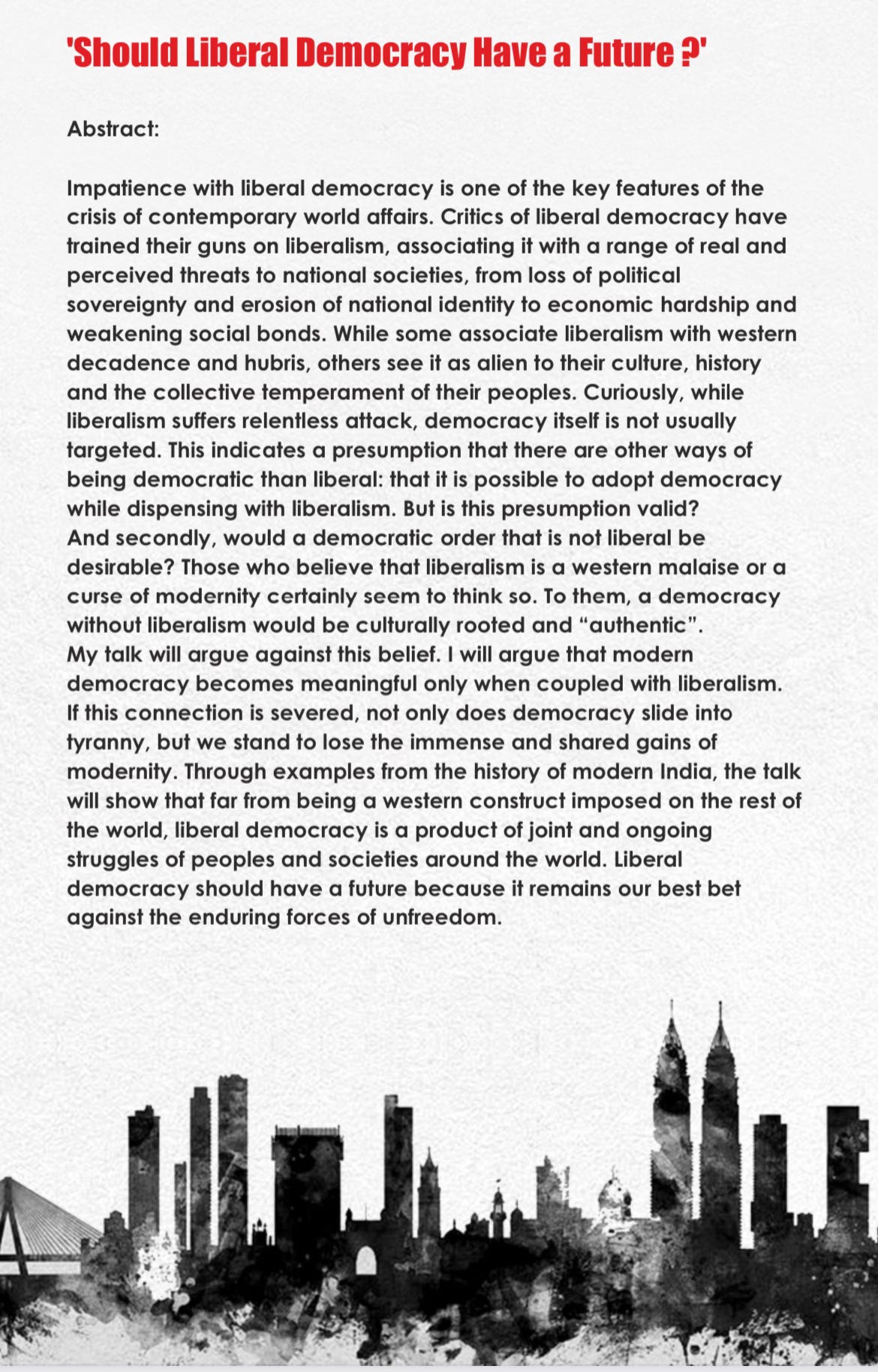
Thoughts welcome.
Hi Atul, I loved your article and the talk you gave on the history, present and future of liberal democracy in India. I particularly liked your insight that people today seem to have a problem with the "liberal" part of liberal democracy while not realising that without liberalism, democracy decays into tyranny. It's truly unfortunate that we are moving back in time when it comes to our political and social order.
Looking forward to read more from you :)